The short answer
Slippage is the difference between the price you expected and the price at which an order actually executes. A higher buy fill or a lower sell fill is adverse slippage. It is separate from an explicit trading fee.
- Measure adverse slippage for buys and sells.
- Use a weighted average when an order has several fills.
- Distinguish execution cost from explicit fees.
Spread, slippage and fees measure different things
Use a consistent reference. Comparing a buy fill to the mid-price includes the effect of crossing the spread; comparing it to the quoted ask answers a different question. Do not count the same cost twice when combining an estimate.
| Term | What it compares | How to inspect it |
|---|---|---|
| Spread | Best ask minus best bid | Record both quotes at one time |
| Slippage | Reference price vs actual average fill | Save quote time and fill details |
| Trading fee | Venue charge for execution | Read the trade confirmation |
Calculate adverse buy and sell slippage
A buy reference of $100 and a fill of $100.60 gives 0.60% adverse slippage. On 5 units, the extra purchase cost is 5 × $0.60 = $3 before fees.
A sell reference of $100 and a fill of $99.40 also gives 0.60% adverse slippage. On 5 units, you receive $3 less than at the reference. A negative value under these formulas means favourable execution, not an extra cost.
Several fills need one weighted price
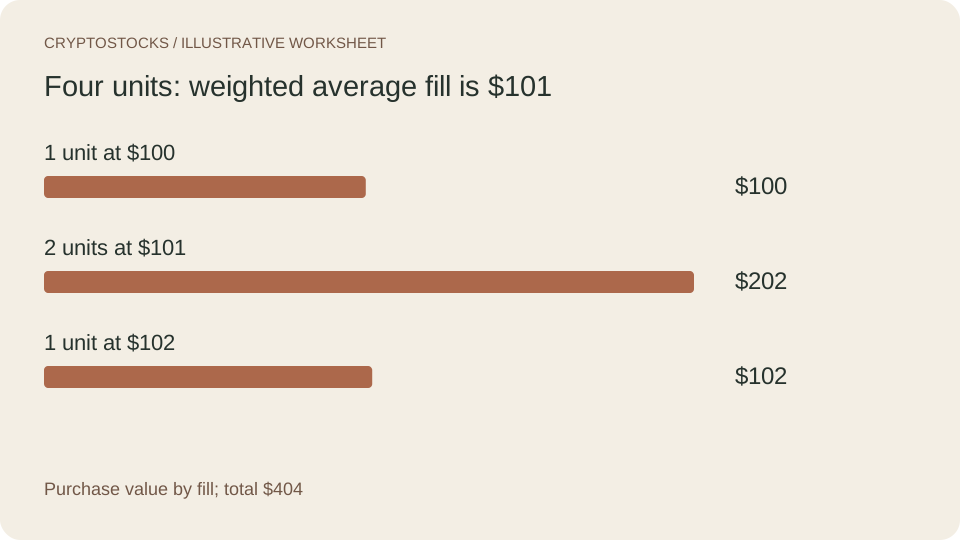
Suppose an order buys 4 units: 1 at $100, 2 at $101 and 1 at $102. Total purchase value is $404, so the average fill is $101. Against a $100 reference, adverse slippage is 1% and the additional cost is $4.
Simply averaging the three listed prices can be misleading when quantities differ. Always multiply each fill price by its units, sum the values and divide by total units.
| Fill | Units | Value |
|---|---|---|
| $100 | 1 | $100 |
| $101 | 2 | $202 |
| $102 | 1 | $102 |
| Weighted total | 4 | $404 / 4 = $101 |
Inspect execution conditions before modelling profit
Low liquidity can increase slippage. A quote describes currently available prices, not unlimited quantity at one level. Fast price changes can also make a recorded quote stale.
A limit order constrains price but can miss the trade or fill only partly. Smaller orders can still face adverse execution. In a journal, preserve the side, order size, quote timestamp, average fill and explicit fees rather than recording only the last traded price.
Profit using actual fills
Buy 5 units at $100.60 and sell at $110, with a hypothetical 0.1% fee on each side. Gross gain is $47; fees are $1.053; net gain is $45.947. The buy slippage is already inside the $100.60 fill, so do not subtract the same $3 again.
Choose the next useful step
- How to calculate crypto profit after trading fees
Work through a crypto profit example with buy and sell fees, then learn which network costs and taxes a simple calculator leaves out.
- Crypto profit calculator
Estimate crypto profit or loss, return on investment and final value from entry price, exit price, quantity and fees.
- Market order vs limit order: a clear beginner comparison
Compare market, limit and stop orders, including execution speed, price control, slippage and the questions to ask before sending one.
Carry these four ideas forward.
- Choose and timestamp the reference quote.
- Use the weighted average fill.
- Keep fees separate from slippage.
- Avoid double-counting the spread.
Continue with original sources.
These links provide definitions and current context. Product rules, regulation and network details can change, so verify time-sensitive information at the source.
Before you move on
Can slippage be favourable?+
Yes. A buy below the reference or a sell above it is favourable execution under the formulas here.
Is a slippage setting an exchange-wide fee?+
No. It is an execution constraint for certain products; its meaning and operation depend on the venue.
Should I subtract slippage again after using actual fills?+
No. If the actual fills already include the execution difference, subtracting it again duplicates that cost.