The short answer
An individual stock represents ownership in one company. An ETF share represents an interest in a fund. A broad fund can spread company exposure, while a narrow or single-stock ETF may remain concentrated.
- Compare a company holding with fund holdings.
- Calculate an illustrative company weight across investments.
- Identify fund costs separately from trading costs.
Compare the research job
Both can lose value. A familiar fund name says little about its largest exposures; a familiar company name says little about its valuation. Read the appropriate disclosures before comparing a price chart.
| Question | Individual stock | ETF |
|---|---|---|
| What drives the exposure? | Company business and finances | Fund objective and holdings |
| Main disclosure to read | Company filings | Prospectus and holdings |
| Concentration check | Company weight in portfolio | Underlying companies and sectors |
| Ongoing fund expense | No fund expense ratio for the share itself | Check the expense ratio |
Work through a simple concentration example
Suppose a fictional $1,000 portfolio is invested entirely in Company A. A 20% fall reduces its value by $200. Now imagine a fund with 20 equal company weights, including A. If only A falls 20% and all other prices stay unchanged, the same $1,000 invested in that hypothetical basket loses $10.
This example isolates one company move. It does not model a broad market decline, unequal weights, dividends or fund expenses. If every holding falls together, the basket can still lose heavily.
Combine direct and indirect holdings
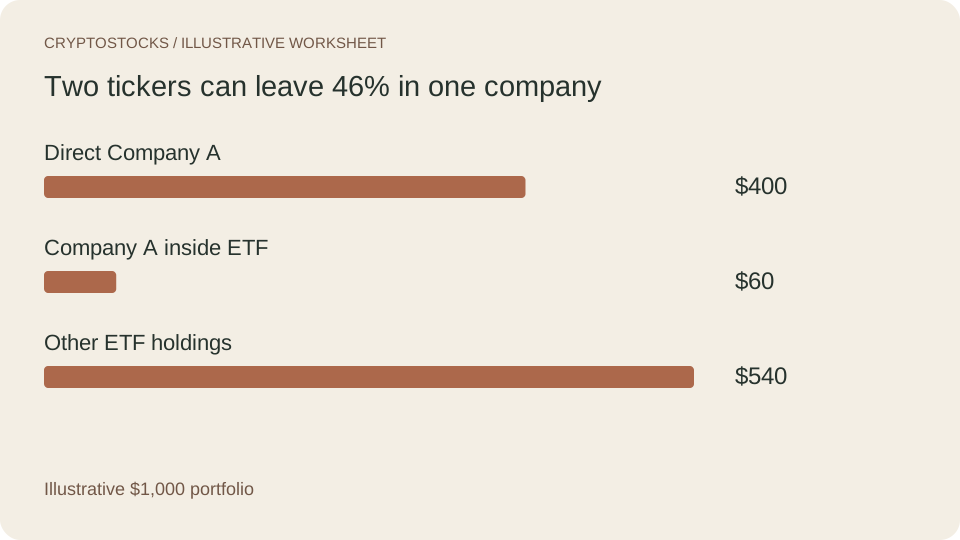
Imagine $600 in a fictional ETF that allocates 10% to Company A, plus $400 directly in A. The indirect exposure is $60, so total A exposure is $460 of the $1,000 portfolio, or 46%. Two tickers have not created two independent risks.
Repeat the arithmetic for other large holdings and sectors. Use holdings from the same reporting date where possible; old weights can misstate the current overlap.
| Holding | Amount invested | Company A exposure |
|---|---|---|
| ETF with 10% A weight | $600 | $60 |
| Direct Company A shares | $400 | $400 |
| Total | $1,000 | $460 / $1,000 = 46% |
Read fund expenses and trading costs separately
Funds deduct operating expenses from their assets. ETF investors can also encounter spreads, commissions and prices above or below net asset value. The prospectus fee table and broker schedule answer different cost questions.
For a simple scale check, 0.20% of a constant $5,000 balance is $10 per year. Actual expense deductions occur within a changing fund value, so this is not an invoice or a precise future cost forecast.
Build a comparison note without predicting returns
Write the investment objective, top exposures, total Company A weight, disclosure date and cost layers. Then state which evidence would cause you to revisit the comparison. Leave future return unknown rather than filling it with past performance.
Choose the next useful step
- Stocks for beginners: what a share represents
Learn stock market basics, how shares relate to businesses, what an exchange does and which questions belong in beginner research.
- Portfolio diversification: holdings, overlap and shared risks
Learn what diversification can and cannot do, how shared drivers create concentration, and how to document a simple allocation framework.
- Investment fee calculator
Compare a constant-return investment scenario before and after an annual fee, including contributions and the estimated long-term value difference.
Carry these four ideas forward.
- Read the actual holdings.
- Add direct and indirect exposure.
- Separate fund and trading costs.
- Compare investment objectives.
Continue with original sources.
These links provide definitions and current context. Product rules, regulation and network details can change, so verify time-sensitive information at the source.
Before you move on
Does every ETF diversify company risk?+
No. Narrowly focused and single-stock products can remain concentrated. Inspect the holdings and mandate.
Can an ETF and a direct stock overlap?+
Yes. Calculate the fund’s indirect exposure and add it to your direct holding.
Does this guide recommend an ETF?+
No. It provides comparison questions and hypothetical arithmetic, without selecting a security for your circumstances.