- Turn a risk percentage into a cash limit.
- Convert the entry-to-stop distance into simple units.
- Recognise when costs and contract rules change the answer.
Start with cash risk, then measure stop distance
Suppose an illustrative account contains $5,000 and its owner chooses to limit a single idea to 1% of that account. The risk budget is $50. This is a planning limit, not a prediction that a stop order will always fill at exactly the chosen price.
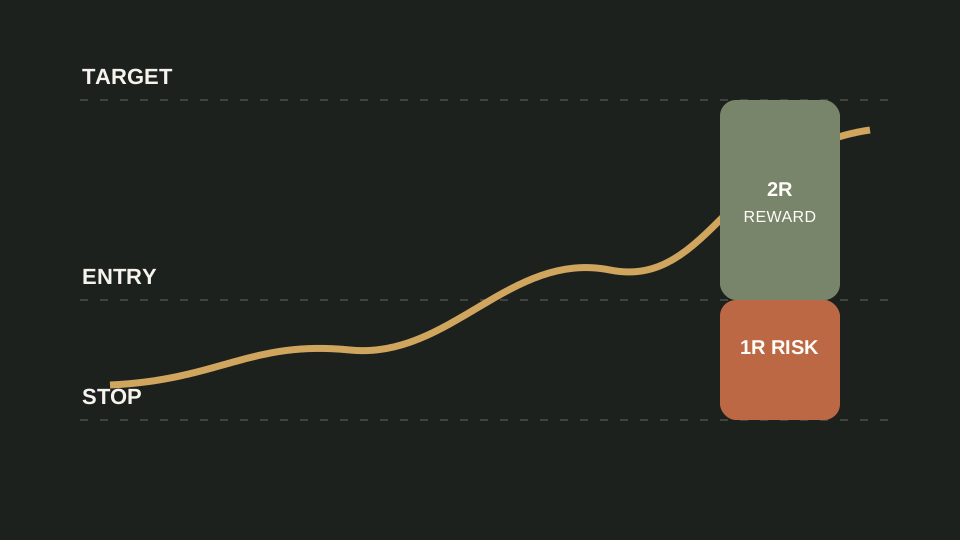
For a long example with a $100 entry and $95 stop, the distance is $5 per unit. Dividing the $50 risk budget by $5 gives 10 units. At the planned stop, 10 units would lose $50 before commissions, spread, slippage and taxes. The notional exposure is $1,000, which is different from the $50 planned loss.
Try the same arithmetic for a short example
A short position entered at $100 with an invalidation stop at $104 has $4 of planned loss per unit. With the same $50 budget, $50 ÷ $4 is 12.5 units before rounding. If only whole units are permitted, rounding down to 12 produces a planned $48 loss before costs.
A stop is not a guarantee of execution. A market can gap through the stop, a venue can apply a contract multiplier, and a quote can be denominated in another currency. A leveraged product also needs a separate margin and liquidation check. For forex, the cash value of a pip depends on the pair, lot and account currency.
Check the order before trusting the result
Write down the account currency, instrument type, unit or contract size, entry, stop, cash risk, estimated trading costs and minimum order increment. If the minimum order would exceed the limit, the responsible calculation is to skip or change the plan rather than enlarge the risk budget.
Use the position-size calculator to vary entry and stop values one input at a time. Use the broader position-sizing lesson for the decision process. Neither a formula nor a calculator can establish whether a trade has a favourable probability.
- Choose the loss limit before calculating units.
- Round down to the allowed increment.
- Include execution and fee uncertainty.
- Recheck notional exposure and margin separately.
One-line worksheet
Illustrative: $5,000 × 1% = $50 risk; |$100 − $95| = $5 per unit; $50 ÷ $5 = 10 units. If expected costs are $6, a strict $50 total risk limit requires a smaller size.
Turn the concept into a reviewable decision.
Write the instrument, the evidence you checked, the important assumption and the condition that would make your original idea wrong. Then use a relevant calculator or paper-trading example before considering real exposure. This step connects the lesson to a repeatable process and makes hindsight easier to detect.
Current prices, regulations, fees and product specifications can change. Verify them at a primary source and keep the educational example separate from your personal financial circumstances.
Carry these four ideas forward.
- State your account currency.
- Write the cash loss limit.
- Check the instrument multiplier.
- Recalculate if entry or stop changes.
Three questions before the next tab.
Choose the answer that best matches the lesson. This is a memory check, not a market signal.
Continue with original sources.
These links provide definitions and current context. Product rules, regulation and network details can change, so verify time-sensitive information at the source.
Before you move on
Can a stop-loss order guarantee my maximum loss?+
No. Gaps and slippage can produce a worse fill than the selected stop price.
Should I use the same number of units for every trade?+
No. A different stop distance changes the loss per unit, so the size that fits a fixed cash limit changes.
Does this formula work for forex lots?+
Not directly. Forex requires the pip value, lot size, currency conversion and broker contract specification.