The short answer
A conventional stop-loss becomes a market order when triggered. A stop-limit becomes a limit order, which controls the acceptable price but may remain unfilled. Neither guarantees that your loss will equal the amount in your plan.
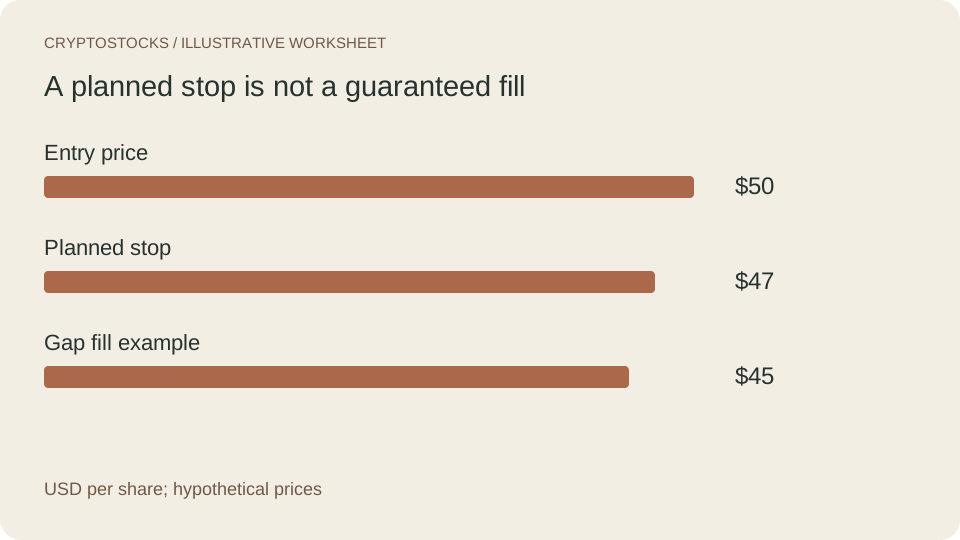
- Separate a stop trigger from an execution price.
- Calculate the loss if a market gaps past a stop.
- Identify what can keep a stop-limit order unfilled.
Compare what happens after the trigger
The term stop-loss is sometimes used loosely. Confirm whether the platform means a stop-market or a stop-limit instruction. The table describes conventional order mechanics, not every venue implementation.
| Question | Stop-loss / stop-market | Stop-limit |
|---|---|---|
| After activation | Market order | Limit order |
| Price constraint | No fixed execution price | Limit price or better |
| Main trade-off | Unexpected execution price | Partial fill or no fill |
| What to verify | Trigger basis and trading session | Trigger, limit and order duration |
A price gap changes the planned loss
Imagine 10 shares bought at $50, with a sell stop at $47. The price-distance budget is 10 × ($50 − $47) = $30 before costs. That number assumes the exit actually fills at $47.
Now suppose the next available fill is $45 after a gap. Selling all 10 shares there creates a $50 price loss. The extra $20 is execution risk; the original position-size arithmetic did not guarantee the exit price.
| Illustrative exit | Loss per share | Loss on 10 shares |
|---|---|---|
| $47 planned exit | $3 | $30 |
| $46 actual exit | $4 | $40 |
| $45 actual exit | $5 | $50 |
A limit can leave the position open
Using a $47 stop and $46 sell limit means the activated order can sell only at $46 or higher. If available buyers are at $45, the instruction cannot sell there. A later recovery may permit a fill, but a continued decline can leave the exposure open.
For a buy stop-limit, the acceptable-price constraint works in the opposite direction: the limit is the maximum purchase price. Confirm both fields before submitting an order.
Record the execution assumptions in your plan
Write a one-line order note: side, quantity, stop, order type after activation, limit if any, duration and eligible session. Ask which price triggers the order and how partial fills or outages are handled.
In paper practice, record two hypothetical outcomes: an exit at the planned stop and an exit beyond it. Comparing both keeps the cash-risk estimate separate from a promise of protection.
Choose the trade-off explicitly
In the $50 share example, a market instruction can exit at $45 while a $46 sell limit may remain open. Your order note should state which uncertainty you are accepting and what you would review if the instruction does not fill.
Choose the next useful step
- Market order vs limit order: a clear beginner comparison
Compare market, limit and stop orders, including execution speed, price control, slippage and the questions to ask before sending one.
- Crypto position size calculator
Calculate crypto position size from account balance, risk percentage, entry and stop price, with an optional cost buffer and clear exposure checks.
- Risk management in trading: cash risk, stops and exposure
Learn practical risk management in trading: cash risk, stop planning, correlation, drawdown and why survival comes before returns.
Carry these four ideas forward.
- Confirm the order type after activation.
- Read the trigger-price definition.
- Model a fill beyond the planned stop.
- Review the unfilled-order scenario.
Continue with original sources.
These links provide definitions and current context. Product rules, regulation and network details can change, so verify time-sensitive information at the source.
Before you move on
Is a stop-loss a guaranteed maximum loss?+
No. A conventional stop-market can execute beyond its trigger. Fees, gaps and partial fills may change the realised loss.
Can the stop and limit prices differ?+
Yes. They have different jobs: one activates the instruction, the other constrains the acceptable fill.
Does this apply identically to every crypto platform?+
No. Use the guide to frame questions, then check the platform’s own order rules and trigger basis.