The short answer
Spot trading exchanges an asset for payment. Futures provide contract exposure to an underlying price; holding a futures position does not by itself give you the underlying coin. Margin and liquidation rules are contract-specific.
- Distinguish an asset balance from contract exposure.
- Compare losses on equal notional amounts.
- Separate expiry, funding and collateral requirements.
Compare the instrument before comparing returns
Custody still matters for spot. A balance on a centralised service has different control and counterparty exposure from an asset held in your own wallet. Margin spot and borrowed assets fall outside the unleveraged comparison.
| Feature | Unleveraged spot example | Futures example |
|---|---|---|
| What is held | Asset balance or custodial claim | Derivative contract |
| Cash required | Purchase value plus costs | Required margin plus costs |
| Forced exit | No margin liquidation from borrowing in this example | Possible margin liquidation |
| Time rules | No contract expiry | Dated expiry or perpetual design |
Equal exposure is different from equal collateral
Consider a fictional asset at $100. Buying 10 units outright creates $1,000 exposure. A linear contract representing 10 units also creates $1,000 exposure. A $10 fall creates a $100 price loss in either example before costs.
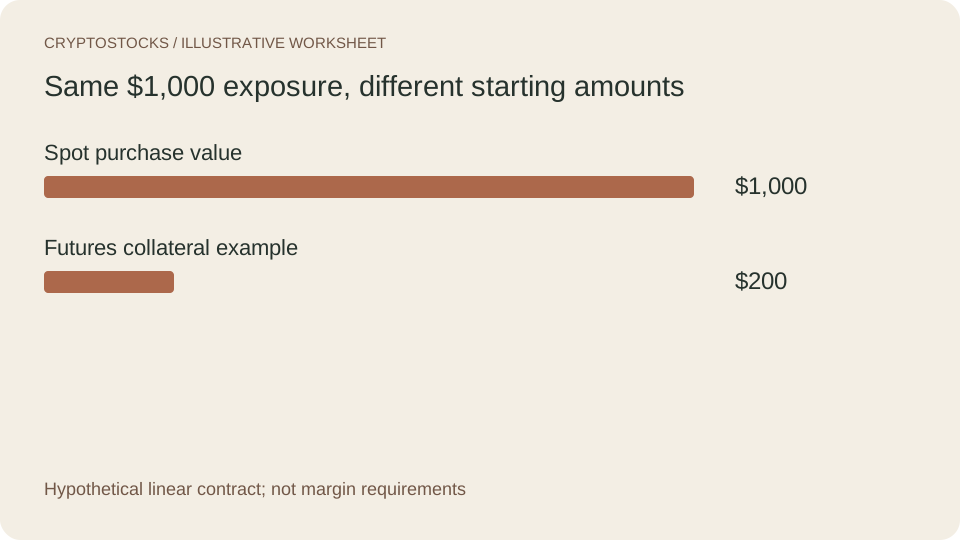
If the futures example starts with $200 collateral, that $100 price loss equals 50% of starting collateral. On $1,000 paid for spot, it equals 10% of starting purchase value. Equal notional exposure produces equal price sensitivity in this model, but a different collateral percentage.
| Illustrative measure | Spot | Linear futures |
|---|---|---|
| Exposure | $1,000 | $1,000 |
| Starting purchase / collateral | $1,000 | $200 |
| Loss on a $10 decline | $100 | $100 |
| Loss / starting amount | 10% | 50% |
Expiry and funding are different costs and obligations
A dated contract has settlement and expiry specifications. A perpetual contract has no scheduled expiry and may use funding payments to help align its price with the spot market. Funding can be paid or received; the direction and timing are product-specific.
Build a contract worksheet with multiplier, settlement asset, margin method, fees, funding or expiry, mark-price method and liquidation rules. Do not import another venue’s settings into the worksheet.
A planned stop does not define liquidation
An exit instruction and a margin requirement do different jobs. A stop reflects your trade plan; liquidation is a venue risk process when collateral becomes insufficient under its rules. An instruction may not execute before that process during a fast move.
Use position sizing to inspect hypothetical price risk, then separately review margin and contract specifications. The site’s simple unit calculator does not model a futures liquidation price.
A two-column research note
Record the same $1,000 exposure under asset custody and contract collateral. Write where the asset or margin sits, what can trigger a forced exit, and which costs persist while the position stays open. Leave a field blank rather than guessing a contract rule.
Choose the next useful step
- Leverage and margin: exposure is not safety
Understand leverage, margin, liquidation risk and why a small deposit can control a much larger market exposure.
- Crypto wallets and security: the beginner checklist
Learn how crypto wallets work, why recovery phrases matter, and how to reduce common phishing and transaction mistakes.
- Crypto position size calculator
Calculate crypto position size from account balance, risk percentage, entry and stop price, with an optional cost buffer and clear exposure checks.
Carry these four ideas forward.
- Name the asset or exact contract.
- Separate notional from collateral.
- Read settlement and ongoing-cost rules.
- Check forced-exit conditions.
Continue with original sources.
These links provide definitions and current context. Product rules, regulation and network details can change, so verify time-sensitive information at the source.
Before you move on
Does a futures position give me coins to withdraw?+
Not by itself. Delivery and settlement depend on the contract, and many products settle exposure without delivering the underlying coin.
Are all futures perpetual?+
No. Dated contracts have an expiry; perpetual products use a different design.
Is unleveraged spot risk-free?+
No. Asset price, custody, platform failure and liquidity remain relevant.